.png)
Table of Contents
Why cheap AI listing design is quietly killing your click-through rate - and what a strategy-first Amazon design process actually looks like.
Somewhere in the last year, you made a reasonable-looking decision. You needed Amazon listing images. Someone quoted you $30 a slide with 24-hour delivery - or you opened ChatGPT yourself, typed a sentence, and got something back that looked clean enough. You uploaded it. Done.
Here's the uncomfortable part: nothing in that process was designed. It was a generation. And the difference shows up in a number you can see in Seller Central right now - your click-through rate.
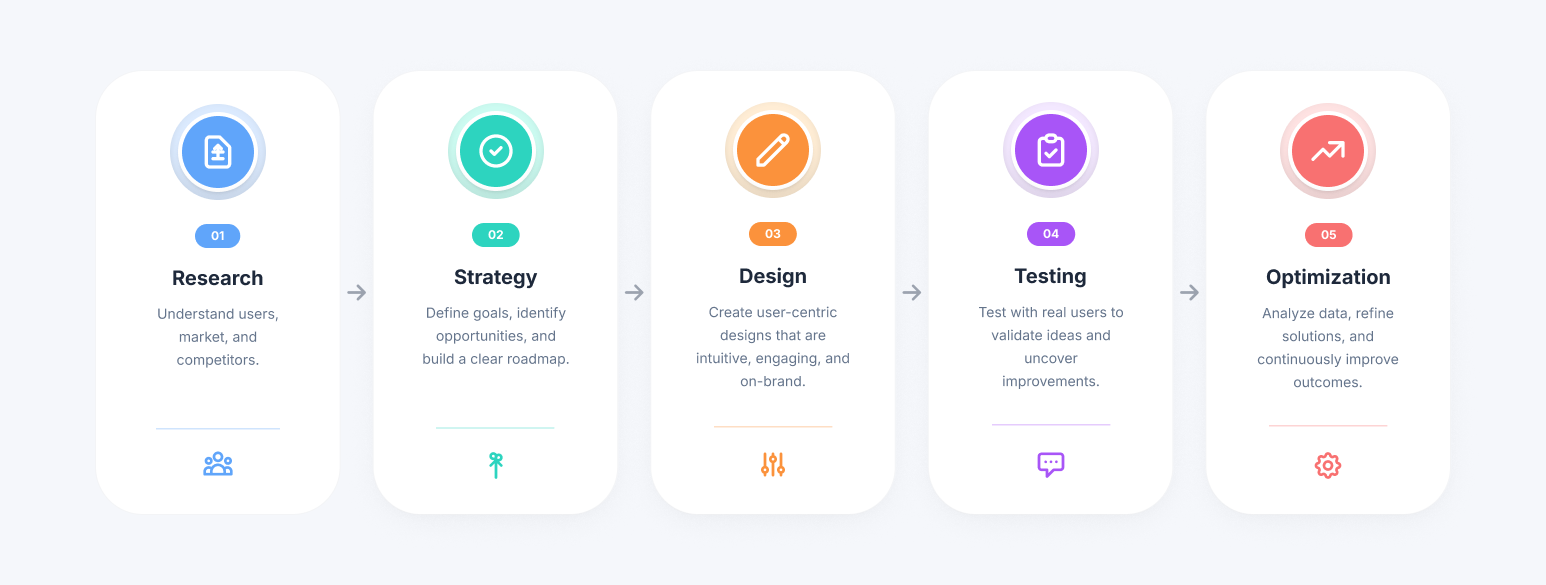
At Cueball Creatives, every listing we touch runs through the same sequence before a single pixel gets placed:
Approach. A teardown of your listing, your top competitors, and your reviews - because your 1-star and 3-star reviews are a printed list of the exact fears stopping the next buyer.
Objective. Every image slot gets one job. Most of them exist to break a specific fear of purchase - not to "look premium."
Strategy. Positioning: the one visual argument for why you, in a search grid of forty near-identical products, that your competitors can't copy.
Execution. One design system carried across listing images, A+ Content, and your storefront - one brand kit, one visual language.
Proof. A/B testing main images and tracking CTR and conversion after launch. Delivering files is not the finish line. Moving the number is.
We don't sell images. We improve the numbers your images are responsible for - clicks on the search page, conversions on the listing.
Want to see the entire "design process" you paid for?
Let's talk about how the cheap version gets made. Whether it's a DIY afternoon or an "emerging designer" on a freelance marketplace, the entire creative process is usually one step long:
"Create professional Amazon listing images for a [your product] in the [your industry] niche. Include benefit infographics and lifestyle images. Make it high-converting."
That's it. That's the strategy meeting.
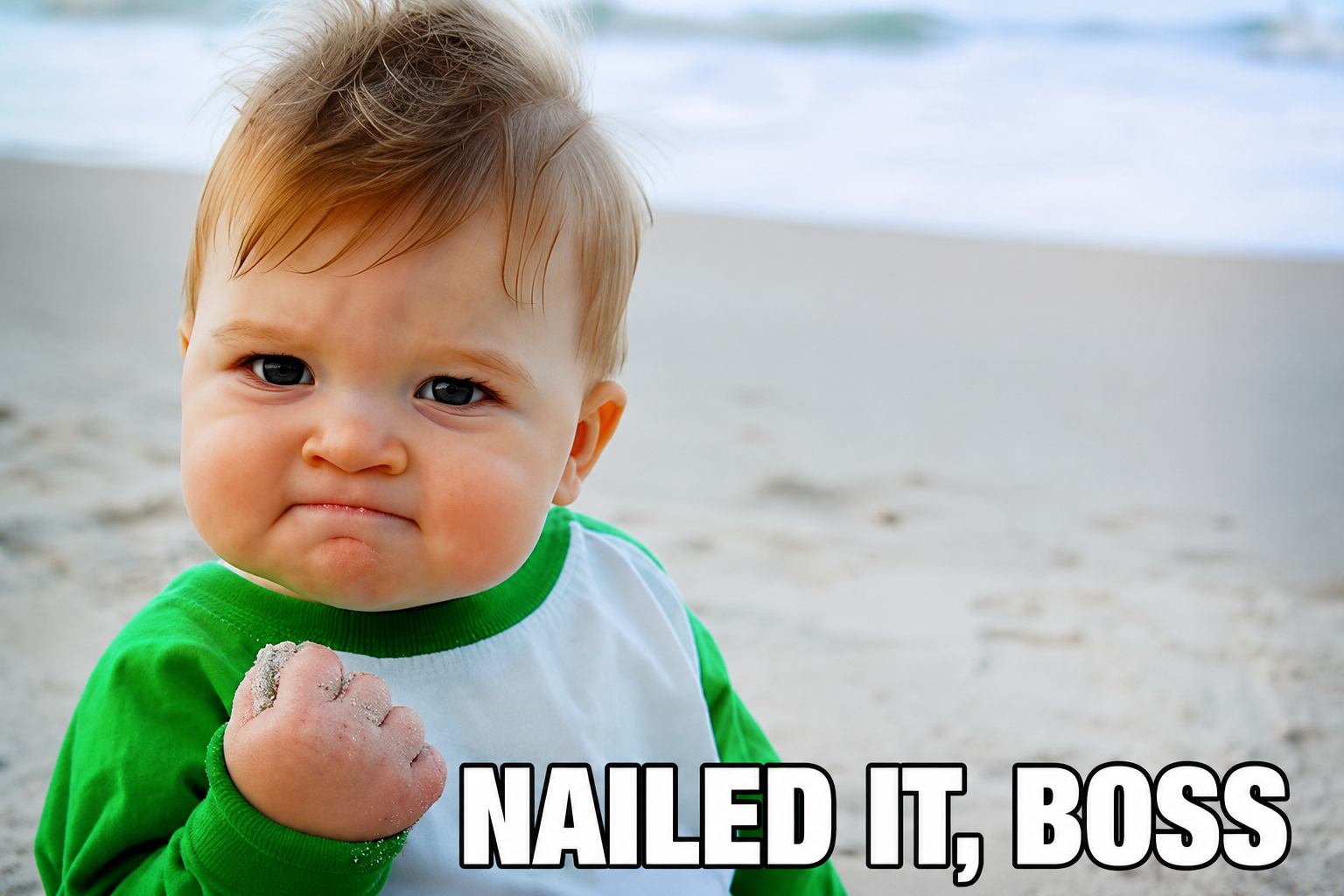
Paste the industry in, ask for copy, ask for images, deliver, invoice. The tool does exactly what it's told: it averages everything it has ever seen in your category and hands back the middle. Which is why every listing built this way has the same floating product render, the same "PREMIUM QUALITY" badge, the same lifestyle shot of a hand that doesn't quite have five fingers.
Zoom in and the tells stack up: garbled text on the packaging label, a product rendered at a size that misleads the buyer, fabric texture that doesn't match what actually ships. Those are the exact details Amazon shoppers zoom in on before they buy - and the exact details a one-line prompt will never get right, because nobody checked.
1. Did anyone read your reviews before designing your images?
No competitor teardown. No review mining. No look at the actual search results grid your main image has to fight in. The prompt can't know that your top competitor's reviews complain about sizing, or that your own reviews say "smells chemical" forty times - which means the single most persuasive image you could make (the one that kills that objection on sight) never gets made.
How Cueball fixes it: every project starts with a teardown of your listing, your top 3–5 competitors, and your reviews. That research writes the design brief. It's the same teardown we do free - before you've paid anything.
2. Can you say what job each of your seven images is doing?
Amazon gives you up to seven to nine image slots. In a strategic stack, each one has a single objective: slot two kills the biggest fear of purchase, slot three proves your core claim, slot four wins the side-by-side comparison, slot five shows the outcome the buyer is actually purchasing. A prompt-generated stack gives you seven variations of "benefits" floating around a render - pretty, interchangeable, and doing nothing in particular.
How Cueball fixes it: we map an objective to every slot before design starts. If an image can't answer "what fear or question does this remove?", it doesn't go in the stack.
3. Have you noticed your listing looks just like your competitors'?
This is the part almost nobody tells you. AI models are trained on the whole category - including every seller you're trying to beat. Ask for "professional listing images in your niche" and you get the category average back. You are literally paying to blend in.
Positioning is the opposite move: finding the visual argument only your brand can make, and building the entire stack - images, A+ Content, storefront - around it. There is no prompt shortcut for that, because it requires studying the grid you compete in and making a decision.
How Cueball fixes it: positioning comes out of the teardown, gets agreed with you first, and then drives your amazon listing design, A+ Content design, and storefront design as one argument - not three disconnected deliverables.
4. Do your images sell - or just describe?
Describing is not selling. Cheap stacks describe: "premium quality," "100% natural," "durable material." Strategic stacks handle the objection and then move the shopper forward - size confidence before they scroll to the Q&A, the comparison chart before they open a competitor's tab. On Amazon, CTA thinking isn't slapping "Buy Now" on an image. It's removing every remaining reason not to click Add to Cart.
How Cueball fixes it: copy and design are built together, by one team, against the objection list from your reviews - not AI copy pasted onto AI images and hoped into converting.
5. Quick one: what's your main image CTR right now?
Ask whoever made your current images one question: what was my main image CTR before, and what is it now?
Silence. No baseline, no Manage Your Experiments split test, no iteration plan. They can't tell you whether the work worked, because nobody was ever going to check. Design without measurement is decoration.
And the stakes of not measuring are real: Amazon's own published data credits well-built A+ Content with up to an 8% average sales lift - and up to 20% for Premium A+. Gains like that exist on the table. Only sellers who measure ever find them.
How Cueball fixes it: we pull your CTR and conversion baseline before redesign, run main-image A/B tests after launch, and iterate - losing images get replaced, winning patterns get rolled across your other SKUs.
6. Have you ever seen your main image at thumbnail size, on a phone?
Most Amazon shopping now happens on a phone. Your main image lives at thumbnail scale, inside a crowded grid, viewed for well under a second. Generated infographics love eight-point text - which turns into visual noise exactly where the buying decision happens.
How Cueball fixes it: every image is checked at search-grid size and on mobile before delivery. If it doesn't read the thumbnail, it doesn't ship.
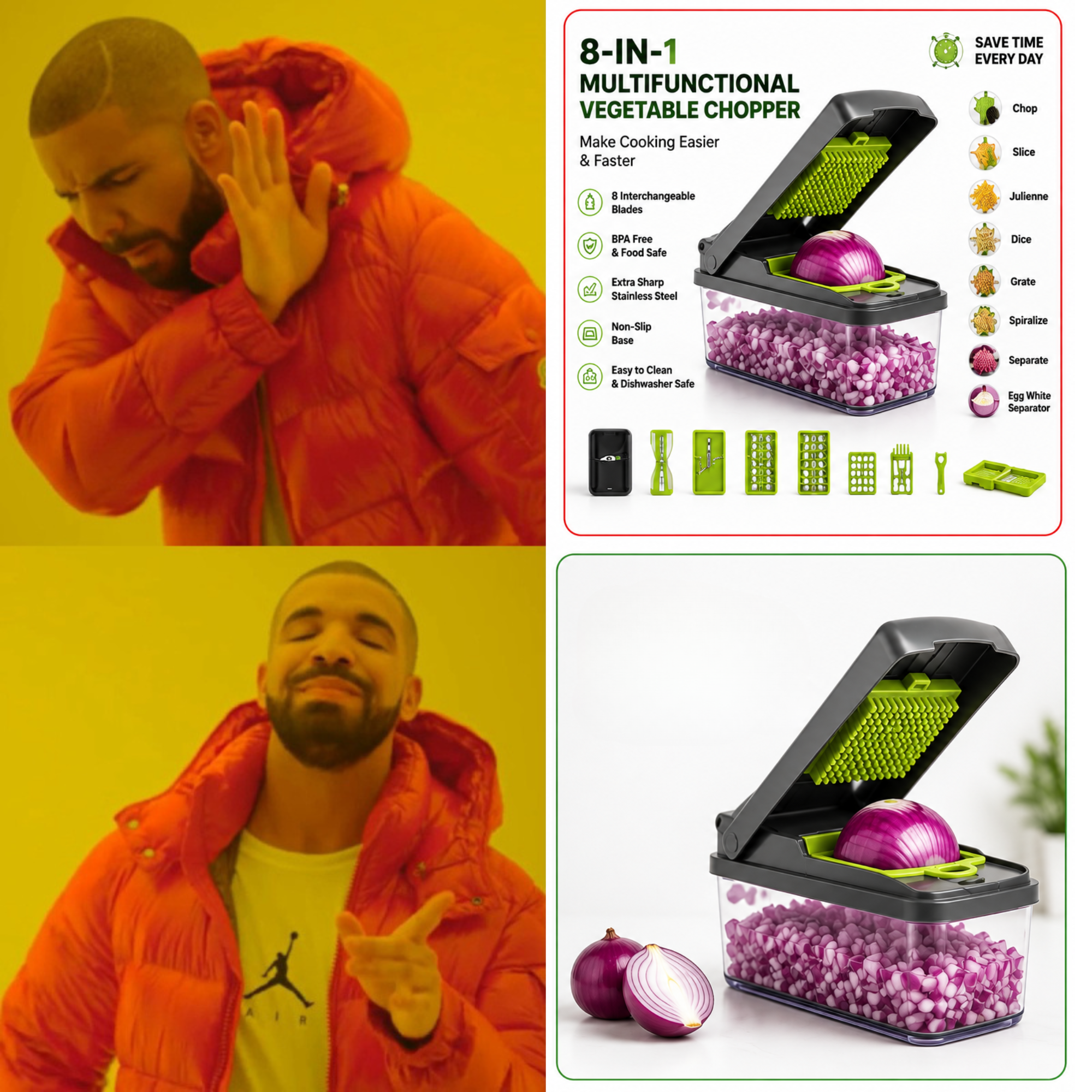
7. Would your images survive an Amazon compliance check?
Main image requirements. Text and badge restrictions. Category-specific compliance. An AI tool doesn't know your category's TOS, and neither does a $30 designer racing through twelve orders a day. Get it wrong and your listing gets suppressed mid-launch - and now the "cheap" images just cost you a week of sales and your ad momentum.
How Cueball fixes it: compliance review is built into delivery. We've audited enough listings across supplements, food, home, and pet categories to know where sellers get flagged before it happens to you.
What else are shoppers quietly noticing?
Fonts that drift between SKUs. A+ Content that doesn't match the listing images above it. A storefront running on a third-party template from 2022. Copy that reads like keywords wearing a trench coat. Each one is small. Together, they tell the shopper this isn't a real brand - and shoppers price that in without ever consciously noticing.
Forget "was it made with AI?" - ask this instead
The tool never decides the result. The input does. So the smarter question about any design work - including ours - isn't whether AI touched it. It's: what did the tool know before it started?
Run your current images through this quick test:
- Did whoever made them know what your competitors' customers complain about?
- Did they know how those competitors have actually been selling this past month?
- Did they know exactly who your buyer is - and what that buyer is afraid of?
- Did they decide which studio style fits your product and vertical, or let the tool guess?
- Does each image have one job - one objection to clear, one fear to remove?
Five eyes, and the images will pull their weight - AI or not. If the honest answer is "the input was one sentence," then the output was a guess, no matter how polished it looks.
For what it's worth, that test is exactly how our own AI runs. Research first - competitor reviews, sales movement, buyer profile. Only then do the tools come out: lifestyle scenes and studio-grade mockups on top-tier paid plans (the Gemini Ultra class, not the free tiers that garble labels and invent textures), with ChatGPT briefed on which studio style fits and which specific fear each image has to kill. The tool is the last step in a chain of thinking - never the first and only one.
Strategy is the product. The tool is just a brush.
How the right way actually runs
Teardown. Your listing and your top competitors - what their customers praise, what they complain about, how their sales have moved over the past month, what drives buyers in your vertical, and exactly who those buyers are. This is the free 15-minute version too - so you see the gaps before spending a dollar.
Strategy map. An objective for every image slot, a positioning angle, and the claims each module has to prove.
Build. One design system across listing images, A+ Content, and storefront, from one brand kit - so every touchpoint a shopper sees reads as the same brand.
Launch and test. Main-image experiments, CTR and conversion tracked against your baseline.
Iterate. Winners scale across SKUs. Losers get replaced. The stack keeps earning.
What it costs - published, no call required
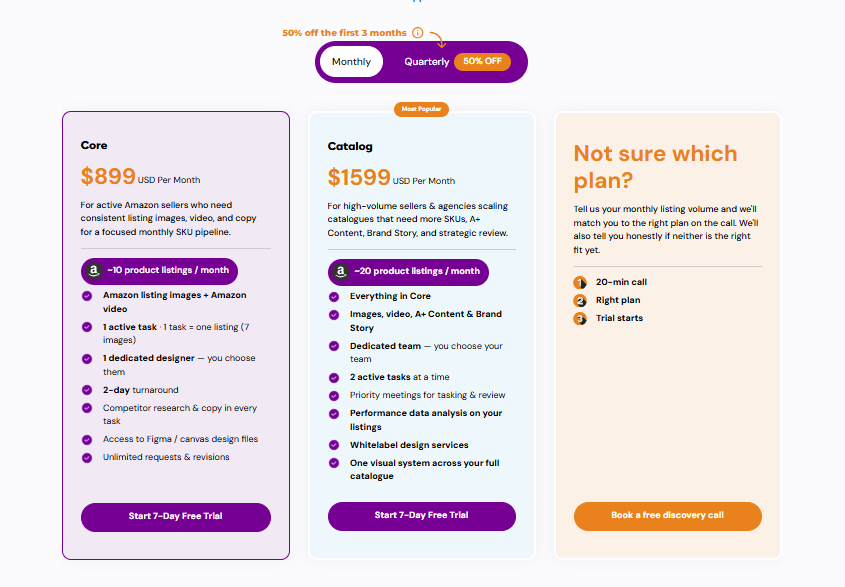
Our Amazon Design plans are priced by catalog size. The Growth/Core tier covers around 10 listings at $899/month. Catalog/Scale covers around 20 listings at $1,599/month. Both include listing image design, A+ Content, and storefront work under one plan - and quarterly billing gets 50% off your first three months.
FAQs
Can't I just write a better prompt myself?
You can write a better prompt. You can't prompt your way to a competitor teardown, a review-mined objection list, or an A/B test result. Those come from work, not wording.
Do you use AI tools?
Yes - in research and in production. Before design, AI mines your competitors' reviews, tracks their sales movement, and profiles your exact buyer. During design, it generates lifestyle scenes and studio-grade mockups on premium-tier subscriptions, under human art direction. What it never does is decide the strategy - which fear each image kills, which claim it proves. That layer is human, and it's the part you're actually paying for.
How do you measure whether the new design worked?
We record your CTR and conversion baseline from Seller Central before redesign, then run main-image experiments after launch and compare. You see the before-and-after numbers, not a folder of files and a wave goodbye.
What's in the free teardown?
Fifteen minutes on your listing: which images are leaking clicks, what each slot should be doing instead, and where your competitors are beating you visually. No commitment, no pitch-first-answers-later.
How many images does a full Amazon listing need?
Amazon allows up to 9 per listing depending on category. Well-optimized listings use every slot - but only if every slot has a job. Nine aimless images perform worse than six deliberate ones.
Recognize Your Listing?
If your Amazon listing images look familiar, they're probably costing you clicks, conversions, and sales every single day. Generic AI-generated visuals and low-cost design rarely create the strategic advantage needed to stand out in Amazon search results. Winning brands invest in Amazon product listing design, Amazon A+ Content, and Amazon storefront design backed by research, competitor analysis, and continuous optimisation-not just attractive graphics.
At Cueball Creatives, we combine competitor research, review mining, conversion-focused design, and A/B testing to build high-converting Amazon listing designs that improve click-through rate (CTR), increase conversions, and strengthen your brand across every customer touchpoint.
Ready To Discuss? Book A Demo
We'll review your current Amazon listing, identify exactly which images are hurting your CTR, uncover missed conversion opportunities, and show you how a strategy-first approach can help you outperform competitors.
Book Your Free 15-Minute Amazon Creative Teardown
Explore Our Amazon Design Plans
Looking for a complete solution? Discover our Amazon Product Listing Design Services, Amazon A+ Content Design, and Amazon Storefront Design plans. Pricing is published upfront, with 50% off your first quarter when you choose quarterly billing.
.webp)
.webp)