Table of Contents
Shoppers who watch product video on Amazon convert at meaningfully higher rates than shoppers who don't, and video content in 2026 lives in four separate placements - product detail pages, Premium A+ Content, Storefronts, and Sponsored Ads - each with different resolution, length, and design requirements. The dominant strategic shift this year is "mute-first" design: most viewers watch without sound, so captions and visual storytelling now matter more than production polish. Amazon's Posts program was fully discontinued in mid-2025; if you're still planning around it, that budget needs to move elsewhere.
Static images used to be enough to launch and coast on Amazon. That window is closing. Shoppers increasingly want to see a product working before they click Add to Cart, not just read that it works - and Amazon's own placement expansion (video now lives in four different spots on a listing's ecosystem) reflects that shift directly.
Why Video Matters More on Amazon Right Now
Product listings with video consistently outperform those without across click-through, time-on-page, and conversion rate. The mechanism is simple: video is the closest a shopper gets to physically handling a product before buying, and on a platform where every competing listing looks like a wall of near-identical static photos, motion is what actually stops the scroll.
Two 2026-specific shifts make this more urgent than it was even a year ago:
- Amazon Posts is gone. The program was officially discontinued in June 2025, with the final shutdown completed July 31, 2025. If any part of your organic content strategy was still built around Posts, that budget and effort need to move - the natural landing spot is your listing video and Storefront content instead.
- Rufus is watching. Amazon's AI shopping assistant now surfaces Sponsored Brands Video in conversational answers to broader category questions, not just narrow keyword matches. A well-tagged, well-targeted video ad can now show up in answers to questions your exact keywords never covered.
The Four Places Video Lives on Amazon (and Why the Specs Differ)
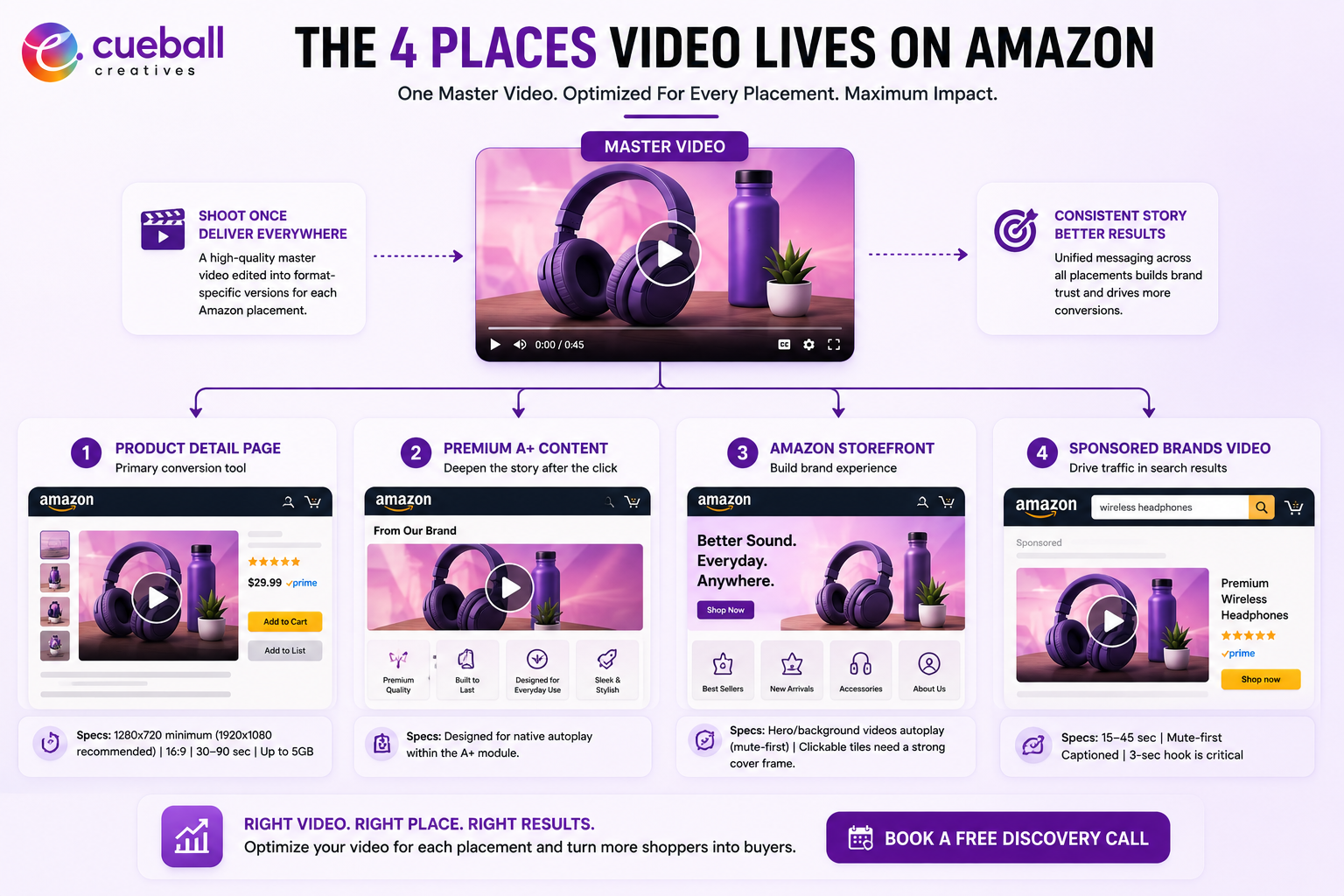
The practical implication: shoot and edit a master file at 1920×1080 or higher, then export placement-specific versions. The same cut rarely works across all four spots without re-editing for length, aspect ratio, and sound-off pacing.
Mute-First Design: The Rule That Changed Everything
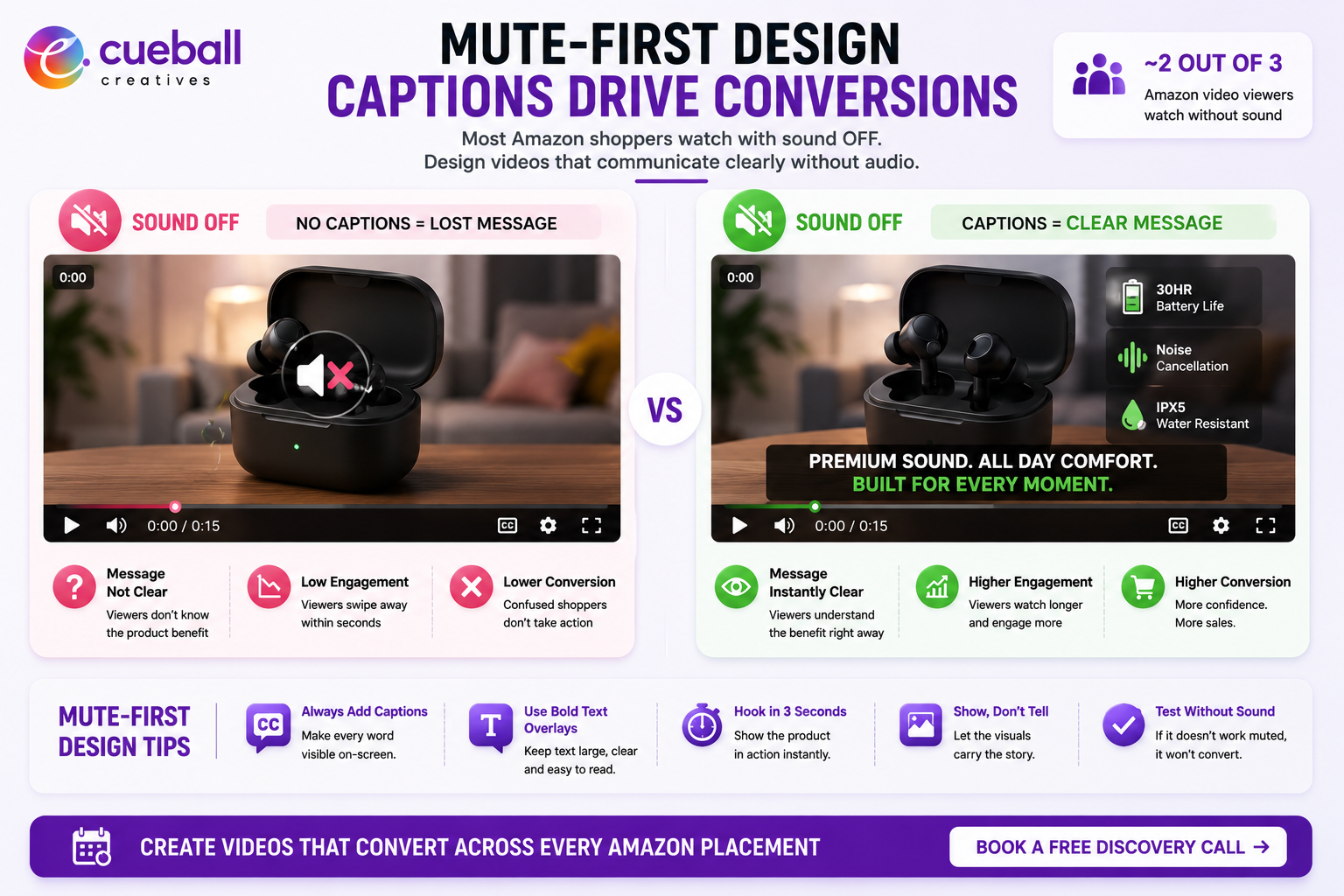
Roughly two-thirds of Amazon video viewers watch with sound off. That single fact should shape almost every creative decision:
- Captions are functionally required, not optional - if the value proposition only lands through voiceover, most viewers never receive it
- Text overlays need to carry the message on their own - large, legible, and readable at thumbnail scale, not just full-screen
- The first 3 seconds have to work silently - a hook that depends on sound design or a spoken line loses the majority of viewers before they've decided to keep watching
Anatomy of a Converting Sponsored Brands Video (15-Second Structure)
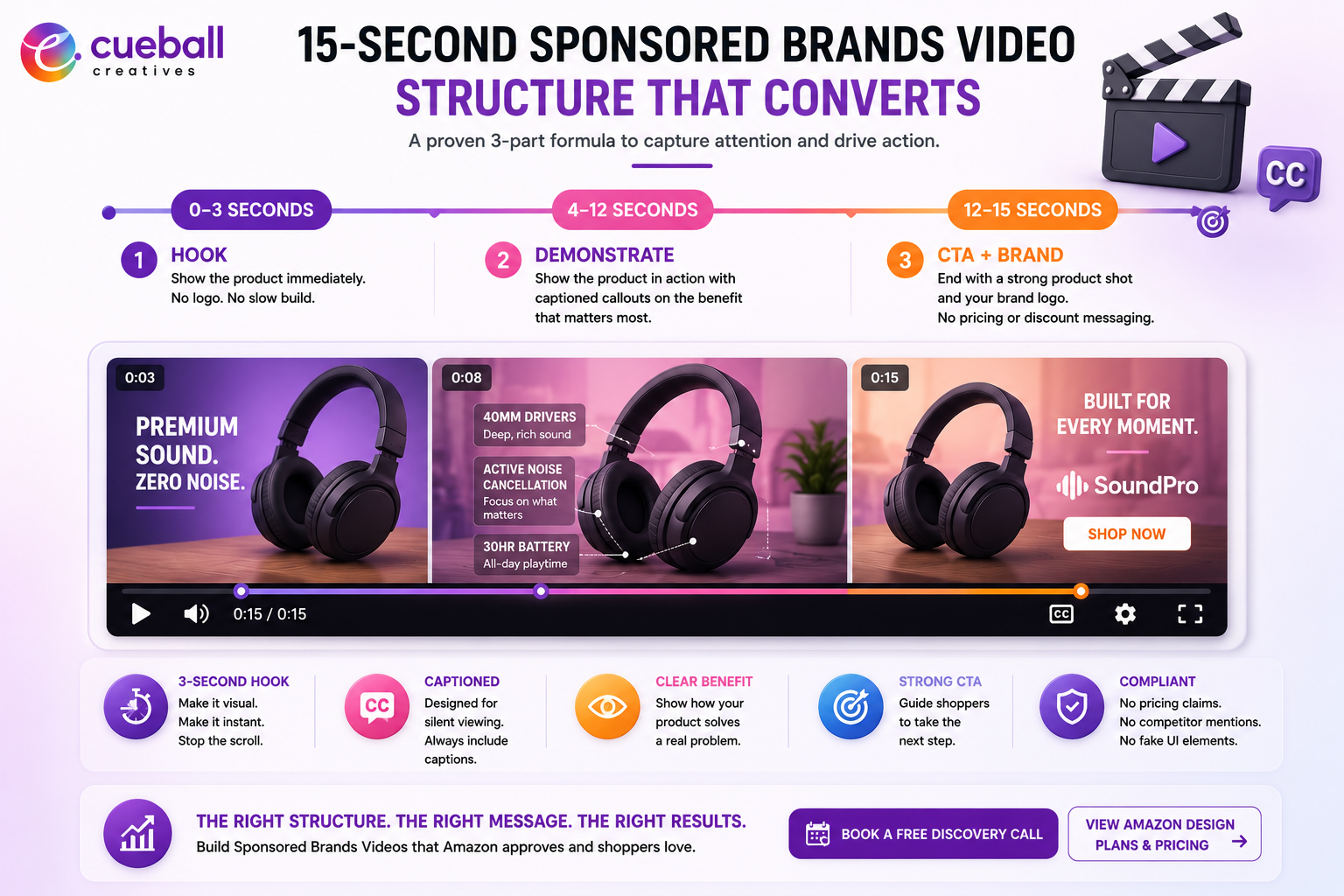
The highest-performing structure in 2026 breaks down into three clear beats:
- 0–3 seconds - Hook. Show the product immediately. No logo intro, no slow build.
- 4–12 seconds - Demonstration. The product doing the thing it's for, with captioned callouts covering the benefit that matters most.
- 12–15 seconds - CTA + brand. A clean product shot with your brand mark as the final frame. Avoid pricing or discount messaging here - it's a common cause of ad rejections.
Common Amazon Video Rejection Triggers
Getting the spec right is only half the compliance picture. Amazon's creative review commonly rejects video for:
- Pricing or discount claims inside the video itself
- Direct competitor mentions or comparisons
- Reproduced customer reviews or testimonials without proper substantiation
- Fake UI elements (mocked-up "Add to Cart" buttons, fake notification overlays) designed to mimic Amazon's own interface
Building compliance checks into the editing process - not catching them after a rejection - saves a launch-week delay you usually can't afford.
Video Content Strategy for Multi-SKU Catalogs
A single hero video per product doesn't scale well past a handful of SKUs. Brands managing larger catalogs are increasingly testing multiple short creative variations per product rather than betting on one expensive production - validating hooks quickly, then applying the winning pattern across the rest of the catalog. That only works with a repeatable production system behind it, not a one-off video shoot per listing.
Amazon Listing Video Checklist
- Placement clarity - is this video cut for the PDP, Premium A+, Storefront, or Sponsored Ads? (They're not interchangeable without re-editing.)
- Sound-off test - does the video communicate its core message with the sound muted?
- 3-second hook - does the first 3 seconds show the product doing something, not building up to it?
- Caption accuracy - do captions match the current listing details exactly? (Mismatches are a common cause of both shopper confusion and compliance flags.)
- Compliance pass - no pricing claims, no competitor mentions, no fake UI elements
- Master file resolution - shot/edited at 1920×1080 or higher before exporting placement-specific versions
FAQ
Does video actually improve Amazon conversion rates?
Yes - shoppers who watch product video on a listing convert at meaningfully higher rates than those who don't, and Amazon's own placement expansion (now four distinct video spots across the shopping experience) reflects how much weight the platform puts behind it.
What are Amazon's video requirements for listings?
Generally MP4 or MOV format, minimum 1280×720 resolution (1920×1080 recommended), 16:9 aspect ratio, up to 5GB file size, with length typically in the 30–90 second range for organic listing video - though exact limits vary by placement.
What happened to Amazon Posts?
Amazon officially discontinued the Posts program in June 2025, with the final shutdown completed July 31, 2025. Sellers who relied on it for organic content should reinvest that effort into listing video and Storefront content instead.
Why does "mute-first" design matter for Amazon video?
Roughly two-thirds of Amazon video viewers watch with the sound off. Captions and visual storytelling that work without audio are essential - a video that depends on voiceover to make its point loses most of its audience.
Can I use the same video across all Amazon placements?
Not without re-editing. Product detail pages, Premium A+ Content, Storefronts, and Sponsored Ads each have different length, aspect ratio, and design conventions - a master file shot at high resolution should be re-cut per placement rather than reused as-is.
What gets Amazon video ads rejected most often?
Pricing or discount claims inside the video, direct competitor mentions, reproduced customer reviews without substantiation, and fake UI elements designed to mimic Amazon's own interface.
Ready for Video That Actually Converts Across Every Placement?
Video is now a Core and Catalog plan deliverable at Cueball - designed alongside your listing images, A+ Content, and storefront, not as a separate production line you have to coordinate yourself.
Book A Free Discovery Call → · View Amazon Design Plans & Pricing