
.png)
Table of Contents
Most businesses know they need more video. What they're less clear on is which kind - and that distinction matters a lot before you start writing checks or signing retainers.
"Motion graphics" is an umbrella term that covers a wide range of deliverables: a 90-second product explainer, a looping social media animation, an animated logo reveal, a data visualization for an investor deck. These are all motion graphics. But they serve completely different goals, require different production timelines, and suit very different budgets. Understanding the difference is the difference between investing smartly and throwing money at the wrong problem.
This guide breaks down what motion graphic design services actually include, which types map to which business needs, what realistic costs look like, and what separates a dependable creative partner from one that just has a polished portfolio.
What Motion Graphic Design Services Actually Mean
Motion graphic design services cover the practice of animating design elements - shapes, typography, icons, data, and brand assets - to communicate information or tell a visual story. It's not a character animation, and it's not a live-action video. It sits in between: more flexible than live footage (you're not limited by physical reality), more structured and communication-focused than full narrative animation.
The core tools of motion design include timing, movement, transitions, and sound. A skilled motion designer uses these to guide a viewer's eye, pace the delivery of information, and make ideas stick. The end result can be anything from a six-second looping Instagram reel to a five-minute product walkthrough - what ties them together is that the visuals are built from graphic design elements set in motion.

This distinction matters for buyers because it shapes what you're purchasing. You're not buying footage. You're buying the translation of your message into a dynamic visual language. If you want to explore the full scope of what's possible, view Cueball Creatives' motion graphics portfolio to see these formats in action across real brand work.
The Main Types of Motion Graphics Services
The easiest way to understand motion graphics services is to break the category into what each format actually does in practice.
Animated Explainer Videos
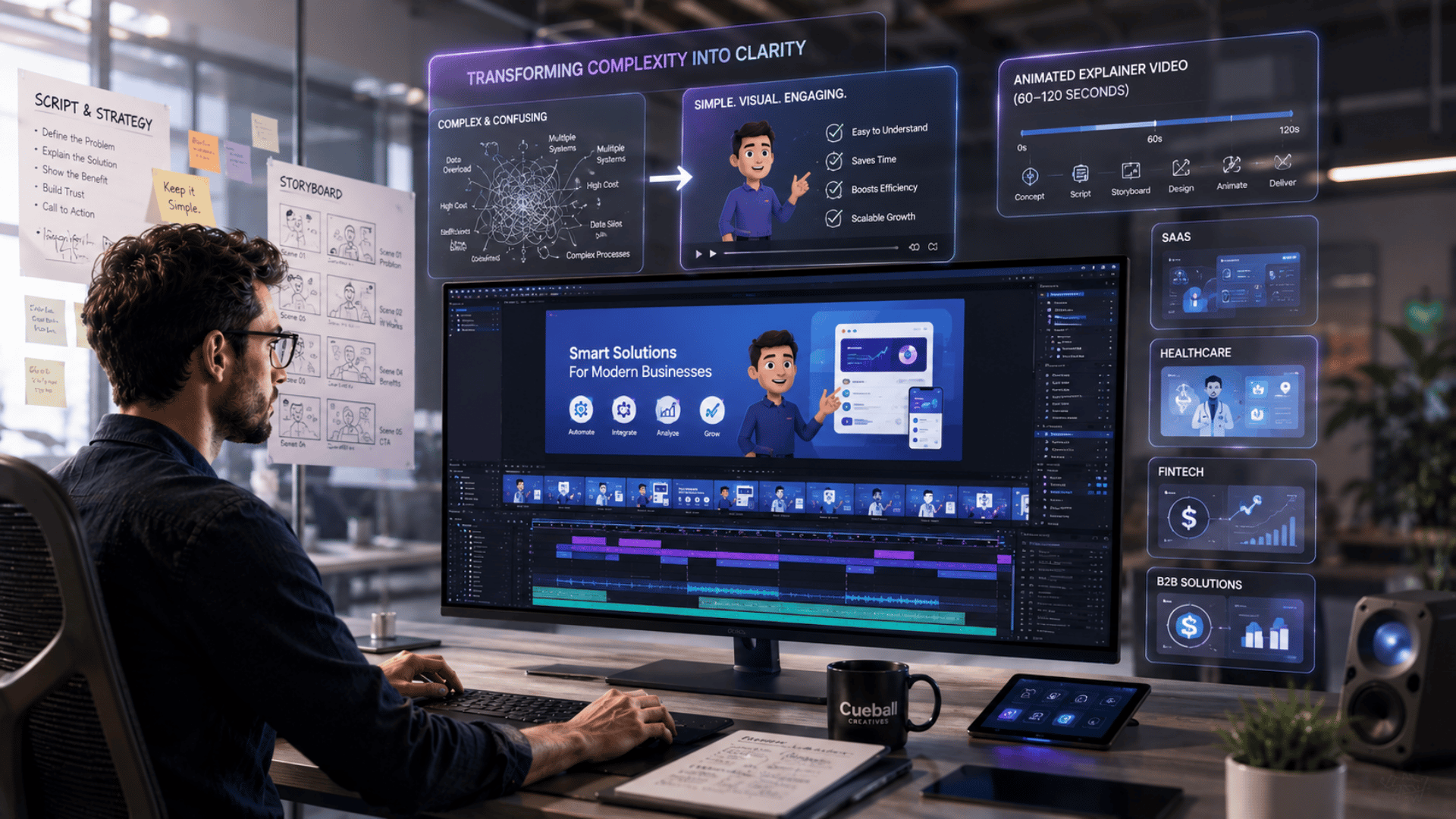
Animated explainer videos are the most recognizable format: typically 60–120 seconds, animated, combining narration with visuals to explain what a product or service does. They're built for audiences who don't already understand your offer.
They work particularly well for SaaS companies, healthcare and fintech brands, and B2B service providers with complex offerings. A 90-second animation can communicate a product concept that would take five minutes to explain in text - and it does so without requiring the viewer to already know your vocabulary.
One thing most generic explainer video content doesn't tell you: the script is where the value lives. An animation built on a vague, jargon-heavy script will produce a vague, expensive video. If the studio you're evaluating doesn't spend serious time on scripting and messaging before touching the animation software, that's a gap worth flagging. Book a discovery call with Cueball Creatives to walk through your brief before committing to a full production.
Brand Motion Graphics
Brand motion graphics cover taking your static logo and brand identity and building it into a motion system: animated logo reveals, branded intro sequences, lower-thirds, transition templates, and animated overlays for video content.
This is less about explaining something and more about consistency. If your brand produces video content across YouTube, LinkedIn, events, and pitch decks, a motion brand system means all of it feels like it came from the same place. It's the visual equivalent of a style guide - except it moves.
Brands that skip this often end up with inconsistent video content where every piece looks like it was made by a different team. Which is sometimes true, but it doesn't have to look that way. Cueball's brand visual identity design service extends this into full motion brand systems for growing teams.
Social Media Motion Graphics
Social media motion graphics - short-form animated content designed for Instagram Reels, TikTok, LinkedIn, and YouTube Shorts - operate under a specific set of constraints: short attention windows, no guaranteed audio, vertical or square formats, and platform-specific algorithms that reward completion rate over reach.
This isn't just "shorter explainer videos." The design logic is different. A 6-second looping animation for Instagram is meant to stop the scroll in the first frame. A 30-second LinkedIn video with bold kinetic typography is designed to communicate without sound. Treating social media motion graphics as a trimmed-down version of a hero video usually produces content that performs poorly on both fronts.
The brands that get this right produce social motion content as its own category - planned for the platform, not adapted from something else. Cueball works directly with social media agencies and in-house marketing teams managing high-volume social calendars.
Data Visualization and Infographic Animation
When numbers need to make an argument, static charts often fall flat. Animated data visualizations sequence information - showing change over time, building a case step by step, highlighting the numbers that matter - in a way that holds attention and drives comprehension.
This format is particularly useful for investor presentations, annual reports, and internal communications that need to convey performance or strategy to non-technical audiences. It also works well as editorial content: brands that publish original research or industry data can animate their findings into shareable assets that attract attention and backlinks. Pair this with Cueball's presentation design service for a fully animated deck that holds the room.
Product Demo and Feature Animation
For software products and physical hardware, showing how something works - without live-screen recording or product photography - is where motion graphics services earn serious ROI. UI walkthroughs, animated feature highlights, and 3D product renders let you demonstrate value without scheduling shoots or recording sessions.
This format is underused in B2B sales enablement. Most companies have an animated explainer video for marketing, but very few have animated demo assets that a sales rep can drop into a proposal or send in a follow-up email. That's a gap most buying journeys actually need filled.
UI/UX and Interactive Motion
Micro-interactions, onboarding sequences, loading animations, and transition effects inside apps and websites are also motion graphic design services - they're just experienced as part of a product rather than as marketing content.
Good UI motion makes a product feel more responsive and premium. It guides users through flows, provides feedback on actions, and reduces cognitive friction. This is typically handled by a motion designer working alongside a product or UX team rather than a marketing content team, and it's usually planned during product design, not retrofitted post-launch. Cueball's UI/UX design service covers the motion layer alongside interface design for growing digital products.
Presentation and Pitch Deck Animation
Animated slide content - for investor pitches, sales decks, and internal comms - uses brand motion graphics to emphasize key data points, visualize processes, and keep audience attention through a presentation that might otherwise be static.
This is worth noting for founders and sales teams specifically: animation enhances a clear, well-structured narrative. It doesn't create one. If the underlying argument in a pitch isn't sharp, adding animated charts won't fix it.

Which Businesses Actually Need Motion Graphics Services
Not every business needs motion graphics services at every stage. Here's an honest look at who benefits most.
Startups and early-stage companies have a specific problem: they need to explain a new or unfamiliar concept to audiences who don't yet have a reference point. A 90-second animated explainer video covers this faster and more memorably than any landing page - particularly for investor outreach, where attention is scarce and first impressions decide whether someone reads further.
SaaS and software products benefit most from UI demos, feature animations, and onboarding content. Users often abandon software not because it's bad but because they don't understand it. Animated walkthroughs reduce time-to-value and support revenue retention in ways that written help docs usually don't.
E-commerce brands have found that animated product videos - particularly 3D renders showing products from angles that photography doesn't easily capture - convert better than static images. This is especially true for products with features that aren't visible in a single photograph. Cueball's unlimited graphic design service includes animated ad creatives and product content for e-commerce teams at scale.
B2B service companies in complex or abstract fields (consulting, legal, finance, logistics) use brand motion graphics to make what they do tangible. Talking about your process in copy is one thing. Showing it unfolding visually is another.

When you probably don't need it yet: If your core positioning and messaging aren't clear, motion graphics won't clarify them. You'll get a polished animation of a confused message. Get the strategy right first, then bring in the animation.
What Motion Graphic Design Services Cost
Cost ranges for motion graphic design services vary more than in most creative services, because the inputs vary so dramatically. Length, style, complexity, revision rounds, scripting, and the model of service (project-based vs. motion design subscription) all affect the final number.
Here's a practical breakdown:
The most common mistake buyers make is comparing prices without comparing scope. A motion design subscription at ~$999/month covers ongoing social media motion graphics and short-form content - it's not the same product as a $10,000 custom explainer built with original character design, professional voiceover, and sound design. They serve different needs at different points in a brand's growth.
What drives costs up: 3D animation vs. 2D, original illustration style vs. flat/icon-based design, scripting included, multiple revision rounds, fast turnaround, and longer video lengths.
What "cheap" motion graphics actually means: Template-based output, no strategic brief, no creative direction, and often no ownership of source files. For short-form social content it may be sufficient. For a video that lives on your homepage for two years, it's usually a false economy.
View Cueball's pricing and plans - flat-rate subscriptions with no hidden fees, no contracts, and a 7-day risk-free trial.
How to Evaluate a Motion Graphics Partner
Most studios look good in a showreel. These are the questions that actually differentiate them when evaluating motion graphics services.
Do they ask about your audience before they ask about your aesthetic?
The first conversation with a good motion graphics partner should cover who the video is for, where it lives, and what it needs to do. If the first question is "what style do you like," that's a sign the creative is being led by visuals rather than objectives.
Is their style range wide enough for your brand?
A studio with a single signature aesthetic will apply that aesthetic to your project whether or not it fits. Look at how different clients' work actually looks from each other in their portfolio. Browse Cueball's portfolio across industries to see the range.
What does their revision process look like, specifically?
Vague revision policies ("unlimited revisions") without clear parameters about scope and rounds tend to create disputes at the delivery stage. Ask for specifics before you sign anything.
Do you own the source files?
This matters more than most buyers realize until they need to update a video 18 months later. Rendered output is fine for most purposes, but source files give you future flexibility. Not every studio includes them by default.
Can they handle your volume needs?
A boutique studio that produces four hero videos a year isn't the right partner if you need 12 social media motion graphics per month. Match the service model to your actual output requirements, not just your quality benchmark.
The Case for a Motion Design Subscription
Project-based motion graphics services have been the default model for a long time - you brief a project, they quote it, they deliver it, you move on. That model works well for one-off hero content. It works poorly for brands that need consistent, ongoing animated output across social media, email campaigns, ads, and internal comms.
A motion design subscription fills this gap. For a flat monthly fee, teams get access to dedicated designers who handle an ongoing queue of requests - social media motion graphics, short video content, brand motion graphics templates, ad creatives - with turnaround times measured in hours rather than weeks.
The practical benefit for growing brands and marketing teams is predictable cost and no project management overhead. You don't re-brief, re-negotiate, and re-onboard every time you need a new animation. The team already knows your brand, your style, and your priorities.
This model suits startups scaling their content volume, social media agencies managing multiple clients, and marketing teams that need regular animated output but don't have in-house motion designers. Start a 7-day risk-free trial with Cueball Creatives - no card required, no contracts.
It's worth noting that a motion design subscription works best for short-to-medium format content. Complex, high-production animated explainer videos or brand motion graphics identity systems still typically require a project-based engagement with more upfront discovery and creative direction.
2025–2026: What's Changing in Motion Graphic Design Services
A few shifts are worth noting for buyers evaluating motion graphic design services right now.
AI-assisted production tools are shortening delivery timelines at mid-tier studios. This doesn't mean the creative work is being replaced - direction, scripting, and brand judgment still require human expertise - but it means faster iteration and lower costs for certain types of output, particularly social media motion graphics.
2D/3D hybrid animation has moved from expensive outlier to accessible option. Mixing flat 2D elements with 3D product renders or environmental depth used to require a significant budget premium. Production pipelines have improved enough that this style is now within reach for mid-market brands commissioning motion graphics services.
Kinetic typography has become the dominant format for social-first content. Text-led animations - where the message is carried by moving type rather than complex illustration - are fast to produce, platform-agnostic, and highly effective without audio. This is the fastest-growing format inside social media motion graphics production.
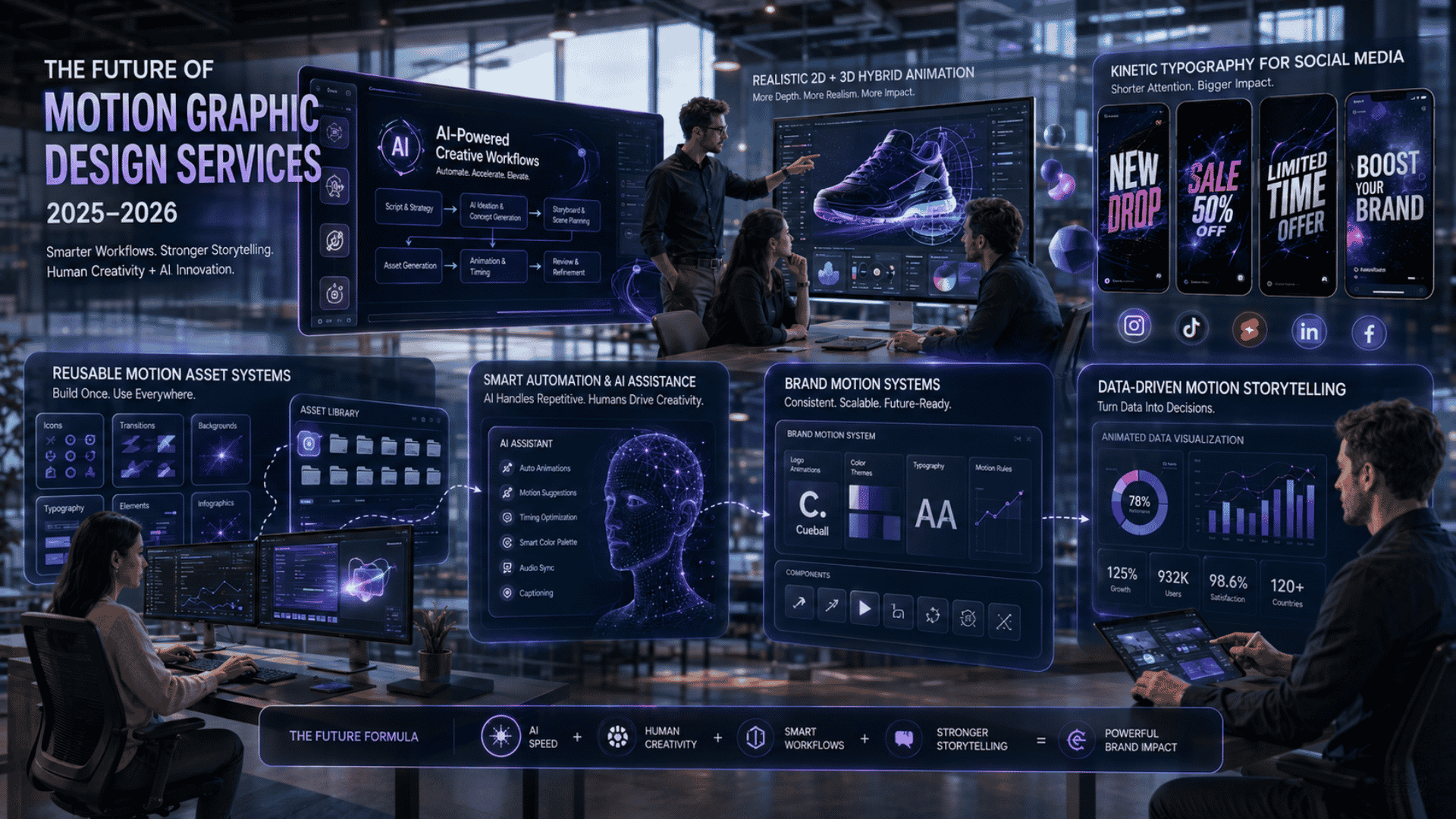
Finally, there's growing demand for reusable animation asset libraries rather than one-off videos. Brands building out brand motion graphics systems want components - animated icons, transition templates, branded overlays - that their team can reuse across multiple pieces without commissioning a new video every time.
Frequently Asked Questions
What are motion graphic design services?
Motion graphic design services are professional creative services that animate design elements - shapes, text, icons, brand assets, and data - to produce video and animated content for marketing, product communication, social media, and brand identity. They differ from traditional animation in that they focus on communication design and visual information delivery rather than character-driven storytelling.
What is the difference between motion graphics and animation?
Motion graphics animate design elements to communicate information or enhance brand motion graphics content. Traditional animation typically involves character-driven storytelling and narrative. Both can appear in the same video, but the distinction matters when briefing a project: motion graphics services are primarily about communication design, traditional animation is about storytelling.
How long does a motion graphics project take to produce?
For a professionally produced 60–90 second animated explainer video, a typical timeline runs 4–6 weeks from brief to delivery - covering scripting, design, animation, and revision rounds. Complex 3D work or multi-video systems can take 8–12 weeks. A motion design subscription for shorter social media motion graphics typically operates on 12–48 hour turnarounds.
Do I need a script before approaching a motion graphics studio?
Not necessarily, but you do need a clear brief: who the video is for, what it needs to communicate, and where it will live. Many studios offering motion graphics services include scripting as part of their service. What you shouldn't expect is for animation to do strategic work that hasn't been done yet.
Can I use motion graphics across all platforms?
Yes, but each platform has specific requirements. Aspect ratios differ (16:9 for YouTube, 9:16 for Stories and Reels, 1:1 for feed posts). Social media motion graphics must be planned per platform - good studios deliver platform-specific cuts rather than asking you to resize a single master file.
What's the minimum budget for professional motion graphic design services?
For a quality 60-second animated explainer video with original design, professional voiceover, and sound design, expect a project floor of around $3,000–$5,000. For ongoing social media motion graphics, a motion design subscription offers better value - typically starting in the $500–$1,500/month range. See Cueball's pricing plans for flat-rate options with no contracts.
Working With a Dedicated Motion Graphics Team
One thing that often goes undiscussed in buying guides: the difference between commissioning individual projects and working with a team that actually knows your brand.
When you work with a dedicated creative partner on an ongoing basis, the first project requires the most onboarding - brand review, style alignment, understanding your communication priorities. By the third or fourth project, that overhead is gone. The team knows what you're building toward, what you've already made, and how to extend it. That institutional knowledge is genuinely hard to replicate project to project with different vendors.
For brands producing motion content regularly, this is where a motion design subscription earns its value beyond just cost predictability. You get a team that accumulates brand context over time, rather than starting from zero with each new brief.

Cueball Creatives operates as exactly this kind of partner - a dedicated creative team handling motion graphic design services, unlimited graphic design, brand visual identity, and more under one subscription. No hiring. No managing freelancers. No starting over each project. Book a demo to see how it works.
Motion That Earns Attention. Design That Builds Brands
Motion graphic design services aren't one thing. They're a family of formats - animated explainer videos, social media motion graphics, brand motion graphics systems, product demos, data visualization - each suited to a different communication problem at a different stage of a brand's growth.
The smartest way to approach them is to start with the specific problem: what do you need your audience to understand, feel, or do? Then find the format and motion graphics services model that solves that problem at the right scale and budget for where you are right now.
The brands that get the most out of motion graphics treat it as a communication discipline, not a production category. The animation is the output. The thinking is the work.
Book a discovery call with Cueball Creatives - Risk-Free 7-Day Trial, No Card, No Contracts.
.webp)
.webp)
